We tend to imagine the life we want will require adding something: a new practice, a different goal, another opportunity, a better plan. But what if the next thing cannot arrive because there is nowhere to put it? In this edition of The Aligned Journal, I reflect on gardens, crowded lives, and the strange courage required to leave some ground open long enough to discover what wants to grow there.
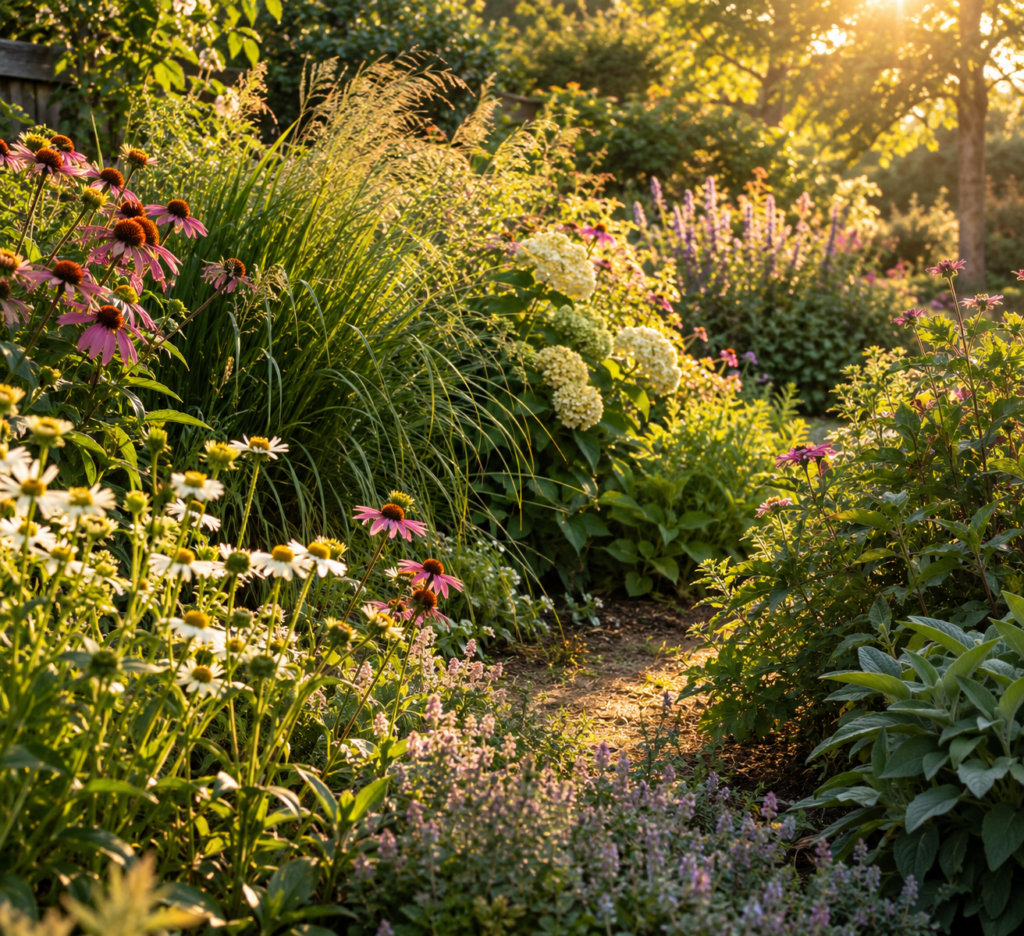
By late summer, the garden shows me what I failed to notice in spring. In May, almost every patch of open ground feels like possibility. The beds are dark and generous. Small plants sit politely where I put them, separated by stretches of soil that make the whole thing look almost too sparse. I know better than to trust that impression, but I do anyway.
Then June arrives. Then July.
The coneflowers widen. Black-eyed Susans lean into one another. Grasses rise and spill over the edges. The hanging baskets I added for color grow heavy with their own weight. Bees move through the pollinator beds as if they have always known the place was meant for them. What looked unfinished a few months earlier becomes abundant.
And then, almost without my noticing, abundance becomes crowding.
I was walking through the garden recently when I stopped beside one of the beds and saw a plant struggling beneath the growth around it. Nothing was wrong with the plant. It wasn’t diseased. It wasn’t failing. It simply wasn’t getting much light.
The plants around it had done what healthy plants do. They had grown. That was the problem. I stood there longer than the situation required, which is often how the garden gets my attention. Sometimes something outside us becomes a mirror before we realize we’re looking into one.
I have spent much of my life adding things. Good things, mostly. Work that matters. Organizations worth serving. People I care about. Projects that interest me. Books I want to read. Ideas I want to explore. Conversations I want to have. Causes I believe in. New things I want to learn. Old things I want to understand differently.
I have been fortunate enough to build a life with very little I would easily describe as unwanted. And perhaps that is why crowding can be so difficult to see. It would be simpler if our lives became crowded only with things we disliked. We could identify the problem, clear it away, and congratulate ourselves on becoming wiser.
But that is rarely how a life becomes full.
A life becomes crowded one meaningful yes at a time. A responsibility we are capable of carrying. An opportunity we are grateful to receive. A relationship we want to nurture. A role that allows us to contribute. A project that excites us. A request we can reasonably accommodate. None of them looks like too much when it arrives. Each one fits. Until, somehow, they all fit. And we no longer do.
The strange difficulty of making room
A particular kind of tiredness does not come from doing things we hate. It comes from caring about too many things at once. I know this tiredness well. For most of my life, competence has been rewarded with more opportunities to be competent. If you can handle things, things have a way of finding you.
You become the person people call. You know how to solve the problem. You can organize the event. You can carry the extra responsibility. You can step in when someone else cannot. You can keep things moving. For years, I thought this was simply what a meaningful life looked like. Perhaps some of it is.
But capability has a shadow. The more we can carry, the longer we can go without asking whether we should still carry it all. I have learned that lesson slowly. There have been seasons when I could tell you exactly what needed to happen next in half a dozen projects and couldn’t tell you, with nearly the same precision, what I needed.
Nothing had gone terribly wrong. That was part of what made it hard to notice. The calendar was full because the life was full. The life was full because I had said yes to things that mattered. And yet something quieter was disappearing. Not purpose. Presence. There is a difference.
Purpose can fill a calendar. Presence requires room inside it. The distinction has become increasingly important to me because we tend to imagine that the life we want is waiting somewhere beyond the life we have. We picture it as an addition.
When I have more time, I’ll write. When this season settles down, I’ll spend more evenings in the garden. When the project is finished, I’ll reconnect with people I’ve been meaning to see. When things slow down, I’ll reflect. When I get through this stretch, I’ll finally have room.
But life rarely sends a notice announcing that the busy season has ended. Something else arrives. And because we are capable, interested, needed, curious, loving human beings, we make room for that too. Or what we call room. Usually, we just move the furniture closer together.
What an empty space is for
The first paths in my backyard began with removal. There was buckthorn growing there, invasive and persistent, and I started clearing it because I wanted less buckthorn. No grand philosophy behind it. No plan to build a meditation garden. No intention to discover some metaphor for human development. I was doing yard work.
But when some of the growth was gone, something unexpected appeared. Space. Eventually, I cut three concentric circles into the ground and began walking them. Later came an infinity loop. Then pollinator gardens. Over time, the place became what I now call the Mind Garden.
None of it was visible when I began. That’s the part of the story I keep returning to. I did not create the garden by deciding everything that should be added to it. The garden began when I removed something. Only then could I see what the clearing might hold.
That has become one of the more persistent lessons of my life: we often ask what we should add before we have considered what needs room. We do this especially when we sense that something wants to change. We buy the book. Start the practice. Join the program. Make the plan. Create another goal. Add meditation between two meetings and call it spaciousness.
I am not mocking this. I have done all of it. Something wonderfully hopeful about our instinct to begin again. But new growth has requirements. A seed does not care how sincere we are about wanting it to grow. It still needs soil, water, light, and room. So do we.
That insight—that growth often begins not with more effort but with space—has become central to how I understand becoming. Sometimes the reason the life we say we want has not appeared is not that we lack commitment. It simply has nowhere to live.
When good things become old things
This is where making room becomes harder. Some things occupying our lives once belonged there. The role mattered. The ambition served us. The responsibility was ours. The relationship with work was appropriate for the person we were then. The identity fit.
There is no villain in the story. There is only time. I have been thinking more about this as I move through my own later seasons of life and work. For decades, I knew myself through certain roles: teacher, administrator, consultant, facilitator, coach. Those identities were not false. I am grateful for them. They formed me.
But something changes when an identity that once gave us room to grow becomes the thing taking up all the room. We can keep being good at something long after it stops being big enough for us.
That may be one of the most disorienting forms of misalignment because the evidence tells us to stay. People still appreciate us. We are still competent. The work still matters. Nothing is obviously wrong. And yet we find ourselves standing in a life that fits the person we have been more comfortably than the person we are becoming.
I have come to think of these moments less as failures and more as thresholds. The old room has not become bad. We have simply changed in relationship to it. Perhaps this is why clearing space can feel unexpectedly like grief. We are not merely removing obligations. Sometimes we are loosening our grip on identities. The dependable one. The person who always says yes. The one who can handle it. The person everyone needs. The expert. The achiever. The helper. Even the identities we cherish can grow so large that nothing else receives light. And because they have served us well, we hesitate to prune them.
The temptation to fill the clearing
The trouble with an open space is that it feels open. Anyone who has cleared a drawer, emptied a shelf, or suddenly found an unscheduled afternoon knows the peculiar pull to put something there. We are remarkably uncomfortable with capacity. A blank space begins to look like inefficiency. An unanswered question starts asking to be solved. A pause becomes an invitation to check the phone. An evening without plans becomes an opportunity to catch up.
We fill what opens. I wonder sometimes whether this is because an open space makes no promises. A crowded life can be exhausting, but it is also reassuring. We know who we are inside it. We know what is expected. We know what tomorrow requires. An open space asks a more unsettling question: What might happen here? There is no immediate answer. That may be precisely why the space matters.
Some things cannot be scheduled into existence. Clarity is one of them. So is a new identity. So is wonder. So is the conversation we didn’t know we needed until we stopped rehearsing what we planned to say. So is the next version of our work. So, often, is meaning.
These things tend to arrive sideways. On a walk. While pulling weeds. Over coffee with someone who asks a better question than the one we have been asking ourselves. In meditation after an ordinary day. On a porch when, for once, we are actually on the porch rather than mentally attending three meetings that haven’t happened yet.
The room does not create the answer.
It allows us to hear what the noise had been covering.
Weeding is not rejection
Gardeners understand something I have had to learn elsewhere: making room is not an act of hostility toward what is removed. I can cut back a plant I love. I can divide something healthy because it has become too large for the bed. I can move a plant because another part of the garden offers better light. I can leave ground unplanted.
None of this means the garden has failed. It means I am tending it. This is a gentler way of thinking about the choices that shape a life. Not everything we stop doing was a mistake. Not every role we leave was wrong. Not every season that ends needs to be explained as a lesson. Not every no is a judgment. Sometimes we are simply making room for what could not grow otherwise.
That is different from decluttering as another improvement project. These days, I’m less interested in the fantasy of creating a perfectly simplified life. I suspect I would find a way to become ambitious about simplicity and ruin the whole thing. The deeper question is not, How little can I have? It is: What needs room now?
That question feels different in the body. It is less accusatory. It doesn’t demand that we purge our lives or reinvent ourselves by Monday morning. It asks us to notice. What is receiving light? What has grown larger than we intended? What are we tending simply because we have always tended it? What part of us has been waiting beneath the taller growth? The life we want may already be trying to grow. We may simply have planted too much around it.
What we cultivate becomes the garden
Every garden is shaped partly by what is planted and partly by what is allowed to remain. A life is too. Attention is one way we cultivate it. Whatever receives our repeated attention gains a certain strength. The worry we rehearse. The obligation we continually renew. The story we keep talking about who we must be. But also, the friendship we protect, the curiosity we follow, the quiet practice we return to, the part of ourselves we finally allow to have some sunlight.
We become, slowly, what we tend. This is why creating room is not merely subtraction. It is an act of attention. It is deciding that something not yet fully formed deserves enough space to become visible. That can be difficult for those of us who prefer evidence before investment. We want to know what will grow before we clear the ground.
Life seldom works that way. The clearing often comes first. This is true of gardens and careers, conversations and identities. We sometimes have to stop filling the space before we know what the space is for. That is not irresponsibility. It is trust. Not certainty that something better will arrive. Trust that an unfilled space has value even before we know what will fill it.
My own garden did not arrive from a blueprint. It became itself over years: three circles, then an infinity loop, then pollinator beds, hanging baskets, wind spinners, places for people to walk and sit and simply be. I kept showing up, paying attention, adding some things, removing others, letting the place tell me what it needed next.
I used to think growth required a clearer plan. Now I’m not so sure. Perhaps becoming is less like construction than cultivation. We make some room. We pay attention. We notice what reaches toward the light. And then we tend it.
The patch of ground
I went back to the crowded bed. The plant underneath hadn’t suddenly become stronger while I stood there thinking about all this. Gardens are wonderfully indifferent to insight. So, I moved a few things. Cut something back. Opened the space around it.
Nothing dramatic happened. There was simply more light where there had been less before. I don’t know what the plant will do with it. That part isn’t mine. This may be the humility at the center of all cultivation. We can create conditions. We can tend. We can remove what is crowding the ground. We can water what matters.
But we cannot command the growing. Maybe our lives ask the same of us. Not to know exactly what comes next. Not to force a new version of ourselves into existence. Not to turn becoming into one more project crowded onto an already crowded calendar. Just to look carefully at the ground we are standing on.
And perhaps, somewhere in the life that has become so wonderfully, meaningfully full, clear one small patch. Then leave it alone for a while. See what reaches for the light.
Reflection Question
What in your life might begin to grow if it finally had enough room and light?
A Gentle Practice
Find five quiet minutes and take a piece of paper. Don’t make a to-do list. Instead, write down three things currently taking up room in your life—not necessarily things you dislike. They may be roles, commitments, habits, expectations, or even identities you value. Beside each one, ask: Does this still need the amount of room I am giving it? Don’t change anything yet. Just notice. Then leave one small space unfilled this week. Resist deciding in advance what it should become.
Continue the Conversation
Thank you for spending a little time here. If this conversation reminded you of someone who may need it, I hope you’ll share it with them. And if it stirred a question that stays with you, I’d love to hear it. Some of my favorite conversations begin after the writing ends.
— Michael
Questions Readers Often Ask
Why is creating space important for personal growth? Because growth needs capacity. When our attention, schedules, and inner lives are continually occupied, we may have little opportunity to notice changing needs, identities, desires, or possibilities. Creating space does not produce growth on command; it creates conditions for something new to emerge.
Does creating space mean doing less? Sometimes, but not necessarily. The deeper question is what deserves the room you have. A crowded life can contain many meaningful things. Creating space is less about minimalism than about noticing whether yesterday’s commitments are leaving enough room for today’s life.
Why can a meaningful life still feel overcrowded? Because crowding is not created only by unwanted obligations. Meaningful work, relationships, service, interests, and responsibilities all require attention. A life can therefore be deeply worthwhile and still become too full to inhabit with presence.
How do I know what to let go of? You may not know immediately. Rather than beginning with elimination, begin with noticing. Pay attention to what receives your time, mental energy, and emotional attention—and to what consistently receives too little light.
What is the relationship between space and alignment? Space gives us enough distance from constant activity to notice whether our choices still fit who we are becoming. Without that pause, it is easy to keep moving according to identities, goals, and commitments that once fit us but may no longer do so. That reflects the larger Spirit Rising principle of allowing awareness and alignment to precede action.

An Engaging Blog Post