Sometimes the most important seasons of our lives don’t announce themselves with dramatic change. Instead, they arrive quietly, disguised as restlessness, uncertainty, or the feeling that something no longer fits quite the way it once did.
In this edition of The Aligned Journal, I explore the difference between being stuck and standing at a threshold and why learning to pause may be one of the most important steps we take before moving forward.
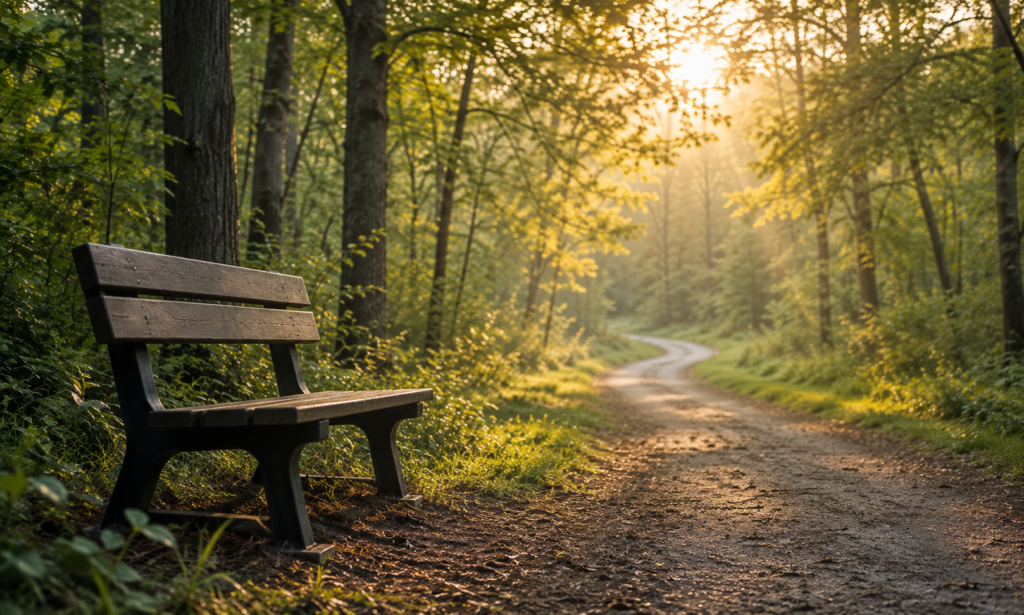
Sometimes, in the middle of an ordinary day, I come across an empty bench and sit down.
It isn’t something I plan. I don’t leave the house thinking about finding a particular park or searching for a quiet place to reflect. It simply happens. As I’m walking, I’ll notice a bench beside a path, overlooking a lake, beneath a canopy of old trees, or tucked into the corner of a city square. Something about it catches my attention, and before I’ve given it much thought, I find myself walking toward it.
I’ve stopped trying to explain why.
Perhaps it’s because a bench asks so little of us. It doesn’t encourage us to move faster or accomplish more. It doesn’t measure our progress or congratulate us on our efficiency. It simply offers a place to stop for a while, and in a world that rarely gives us permission to pause, that feels like a quiet act of generosity.
Once I’m sitting, I rarely reach for my phone. I don’t open my laptop or begin making notes. More often, I watch.
Children seem to notice benches differently than adults do. They climb on them, stand on them, jump off them, or use them as the starting point for games only they understand. Adults, on the other hand, usually pass without a glance, their attention already fixed on wherever they are going next. Every so often someone does stop. An older couple sits together without feeling the need to fill the silence. A runner catches her breath before continuing down the trail. Someone unwraps a sandwich during a lunch break while watching the world move around them.
Nothing extraordinary happens.
And yet I almost always leave feeling as though something important has.
For a long time, I couldn’t explain that feeling. It wasn’t inspiration, at least not in the dramatic sense we often imagine. I wasn’t sitting there waiting for profound insights or life-changing revelations. Most days I simply returned to whatever I had been doing before.
What changed wasn’t the world around me.
It was the pace at which I was experiencing it.
The longer I sit, the more I begin noticing things that had probably been there all along. The sound of wind arriving a few moments before it reached the trees. The way strangers instinctively smiled at toddlers but rarely at one another. The rhythm of conversations that drifted between laughter and silence without either one feeling awkward.
It occurs to me that life speaks very quietly.
Not because it is trying to hide, but because it has never needed to compete with the noise we create.
Perhaps that is why so much of what matters can be missed while we are rushing from one commitment to the next. We become so accustomed to moving that we begin believing movement itself is evidence of progress. Full calendars reassure us that we’re productive. Completed tasks convince us we’ve spent the day well. Even our moments of rest become scheduled, measured, and evaluated according to how effectively they prepare us to become productive again.
Somewhere along the way, we stopped seeing stillness as part of living.
Instead, we began treating it as an interruption.
I’m not suggesting that busyness is the enemy. Much of what gives our lives meaning requires effort, responsibility, and discipline. Families need our attention. Communities depend upon our participation. Meaningful work asks something of us. There are seasons when life naturally moves at a faster pace, and there is nothing inherently unhealthy about that.
The difficulty comes when we forget how to recognize the seasons that are asking something different.
Not every chapter of life is inviting us to produce.
Some are inviting us to perceive.
That distinction has become increasingly important to me over the years, particularly through the privilege of sitting with people as they sort through the questions that bring them to coaching. Rarely do they begin by talking about identity or purpose. They usually arrive carrying something far more practical. A career decision. A relationship that has become complicated. A leadership challenge. The possibility of retirement. The uncertainty of what comes next.
Those questions matter.
But they are often only the visible surface of a much deeper conversation.
As we begin exploring the circumstances, another question gradually makes itself known. It usually doesn’t appear all at once. Instead, it emerges quietly, almost reluctantly, as though it has been waiting for enough room to finally introduce itself.
“I don’t know who I am anymore.”
The words vary.
“The things that used to motivate me don’t seem to anymore.”
“I should be happy, but something feels different.”
“I can’t explain it. It’s just…not the same.”
I’ve heard some versions of those sentences countless times, and every time they remind me of something I have experienced myself. There are moments when life doesn’t ask us to solve a problem. It asks us to notice that we have changed.
That can be surprisingly difficult to accept because most of us have been taught to respond to discomfort by taking action. If we’re uncertain, gather more information. If we’re dissatisfied, work harder. If we’re restless, set another goal. Those responses serve us well in many situations. They help us grow, develop, and accomplish meaningful things.
But eventually many of us arrive at a place where greater effort no longer produces greater clarity. The old strategies haven’t failed. They’ve simply taken us as far as they were meant to take us.
For a long time, I interpreted those seasons as signs that something was wrong with me. I wondered whether I had lost my ambition or become less motivated. I questioned why achievements that once would have energized me now seemed to produce only a brief sense of satisfaction before another question quietly took their place.
Looking back, I think I misunderstood what was happening. I believed I was trying to recover from the person I used to be. Life was inviting me to become someone I had not yet imagined. That realization did not arrive all at once. It almost never does.
It came the way seasons arrive. Quietly enough that you don’t notice the change on any particular day, until one morning you realize the air feels different, the light has shifted, and the landscape you walk through each day has been transformed without ever asking your permission.
It was only much later that I found a word for experiences like that.
Thresholds.
A threshold is such an ordinary thing that we seldom notice it. We cross dozens of them every day without giving them a second thought. A doorway marks the place where one room ends and another begins. We step across it almost unconsciously, already thinking about whatever waits on the other side.
The thresholds that shape our lives are rarely so obvious.
There is no doorway announcing that your understanding of success is about to change. No sign appears when the role you’ve faithfully occupied for years begins to feel too small. No voice quietly whispers that the version of yourself you’ve spent decades becoming has carried you exactly where it was meant to—and that another chapter is waiting just beyond what you can currently see.
If you’re navigating a season like this, the RISE UP Assessment can help uncover the internal patterns shaping how you think, decide, and lead.
Instead, those moments often arrive disguised as uncertainty.
That may be why we resist them.
Uncertainty has an uncomfortable way of exposing our instinct to regain control as quickly as possible. We search for answers before we’ve fully understood the question. We ask trusted friends what they would do. We make lists of pros and cons. We read books, attend workshops, listen to podcasts, and hope that somewhere, someone has already figured out the next step we cannot yet see for ourselves.
There is wisdom in seeking guidance. I have spent much of my own life learning from teachers, mentors, authors, and thoughtful friends. Their perspectives have shaped me in ways I will always be grateful for.
But there are some seasons that cannot be navigated by borrowing someone else’s map. Not because the map is wrong. Because you have entered territory that only you can walk.
That realization has humbled me more than once.
For years I believed that growth was primarily about acquiring something new. New knowledge. New skills. New experiences. Another certification. Another framework that might help me understand people a little more deeply or serve them a little more effectively. Much of that learning became part of who I am, and I wouldn’t trade it for anything.
Yet eventually I began noticing something unexpected. The questions that mattered most were no longer asking me to add something. They were asking me to let go.
-
- To let go of definitions of success that no longer fit.
-
- To let go of identities I had outgrown.
-
- To let go of the quiet belief that my worth was somehow connected to how much I accomplished or how useful I could be to everyone around me.
Letting go is a different kind of work than striving. It cannot be measured on a checklist.
No one congratulates you for releasing an identity that has quietly become too small. There are no certificates for becoming more present. No promotions for discovering that you no longer need to prove something you once believed was essential.
Much of that work happens invisibly.
Perhaps that’s why it often feels lonely.
I wonder if that is one of the reasons we struggle to recognize thresholds while we are living through them. Our culture has taught us how to celebrate beginnings. We celebrate graduations, weddings, new jobs, promotions, and retirements. We know how to honor arrivals.
We are less comfortable honoring the space in between. The months when someone is quietly reconsidering the direction of their life. The season when a parent realizes the house has become unexpectedly quiet. The executive who discovers that another promotion no longer answers the question they’ve been carrying. The caregiver whose identity has been shaped by caring for others and now finds themselves wondering who they are when that season comes to an end.
These are not failures.
Neither are they interruptions.
They are crossings.
Some of the most meaningful changes in our lives happen long before anything changes on the outside. They begin beneath the surface, where no performance review, social media post, or résumé can capture what is taking place. An identity begins loosening its grip. A deeper value quietly rises to the surface. The questions we once asked lose their urgency because we have slowly become someone capable of asking better ones.
I’ve come to believe that these seasons deserve far more patience than we usually give them. Nature seems to understand this instinctively.
No gardener stands over a perennial in early spring demanding that it bloom by Tuesday. We understand that roots and shoots follow rhythms we cannot accelerate. We prepare the soil. We provide water and sunlight. Then we wait, trusting that life knows something about becoming that cannot be forced.
Oddly enough, we extend that grace to gardens more readily than we extend it to ourselves. We assume our own growth should be immediate, measurable, and efficient. When it isn’t, we conclude that we’ve fallen behind.
What if we haven’t? What if what feels like standing still is actually the slow work of growing roots?
As I’ve reflected on the benches that have quietly become companions over the years, I’ve realized they have never given me answers. They have given me perspective.
They have reminded me that the world continues turning whether I hurry or not. That children laugh without checking the time. That trees do not compare themselves to other trees. That seasons arrive without announcing themselves. That ordinary moments often contain far more wisdom than we notice while rushing past them.
Most importantly, they have reminded me that I don’t always need to leave with certainty. Sometimes it is enough to leave with greater attention.
I usually stand after fifteen or twenty minutes, brush a few leaves or wood chips from my clothes, and continue walking. The bench remains exactly where it was before I arrived, ready for the next person who needs nothing more complicated than a place to pause.
-
- The path ahead has not changed.
-
- The work waiting for me has not disappeared.
-
- The questions I carried there may not even have been answered.
But I am almost never the same person who sat down. And perhaps that is the quiet gift of every threshold. It is easy to believe that crossing into a new season requires one bold decision, one defining moment, or one dramatic act of courage. Sometimes it does.
More often, I suspect it begins with something much smaller.
It begins by slowing down long enough to notice that the person asking the question is no longer the same person who first carried it.
So if life has felt unfamiliar lately…if the goals that once inspired you seem strangely incomplete…if you’ve been tempted to believe that your uncertainty means you’ve lost your way…consider another possibility.
Perhaps you are not stuck. Perhaps life is inviting you to stop long enough to recognize that you have arrived at a threshold. And before asking where you are supposed to go next, perhaps the better question is this: Who is stepping across it?
Reflection
Where in your life might you be trying to solve a problem that is actually inviting you to notice a transition? Before asking, “What should I do next?” spend a few moments with a different question:
Who am I becoming in this season of my life?
Don’t rush to answer it. Simply notice what begins to surface.
Looking for another guided reflection? Visit Room to Reflect for this month’s five-minute practice.
Five-Minute Practice: Find a Bench
Sometime this week, intentionally pause. It doesn’t have to be at a bench. It could be a chair on your porch, a park, a coffee shop, or even a place that simply invites you to stop for a few minutes.
Put your phone away. Resist the urge to accomplish anything. Simply notice.
-
- Notice the people around you.
-
- Notice the sounds you usually overlook.
-
- Notice what begins to settle within you when you stop trying to get somewhere.
As you leave, don’t ask yourself whether anything remarkable happened. Instead, ask: What did I notice today that I might have missed if I had kept moving?
Questions Readers Often Ask
-
- What does it mean to be at a threshold? A threshold is a season of transition between one way of being and another. It often feels like uncertainty because the old no longer fits, while the new has not yet become clear.
-
- How do I know if I’m truly stuck or simply in a season of transition? Being stuck often involves repeating the same patterns without movement. A threshold feels different. Although there may be uncertainty, there is usually a quiet sense that something within you is changing, even if you can’t yet describe it.
-
- Should I make a major life decision while I’m in a threshold? Not necessarily. Some thresholds call for action, while others call for attention. Before asking what to do next, it can be helpful to understand what this season is inviting you to notice about yourself.
-
- Why is slowing down so difficult? Many of us have learned to measure our worth through productivity and accomplishment. Pausing can feel uncomfortable because it asks us to relate to ourselves differently—not by what we achieve, but by how present we are to our own lives.
-
- What if I don’t have all the answers yet? Most meaningful transitions unfold over time. Clarity often grows through paying attention rather than rushing toward certainty. It’s okay to let some questions accompany you for a while.
Still have a question? I’d love to hear what’s resonating with you. Explore more essays in The Aligned Journal, or learn more about Spirit Rising Coaching.
Continue the Conversation
Some conversations aren’t meant to end when the final paragraph is read.
If this reflection stayed with you, I invite you to continue exploring The Aligned Journal, where each essay builds on the questions that shape how we think, lead, and live with greater alignment.
If you’re looking for deeper support in navigating your own season of transition, you can also learn more about Spirit Rising Coaching.