A life can be filled with meaningful work, good people, and worthwhile commitments—and still become too full to inhabit. In this edition of The Aligned Journal, I reflect on what a late-summer garden can teach us about attention, presence, and the quiet difference between having a full life and an overfilled one.
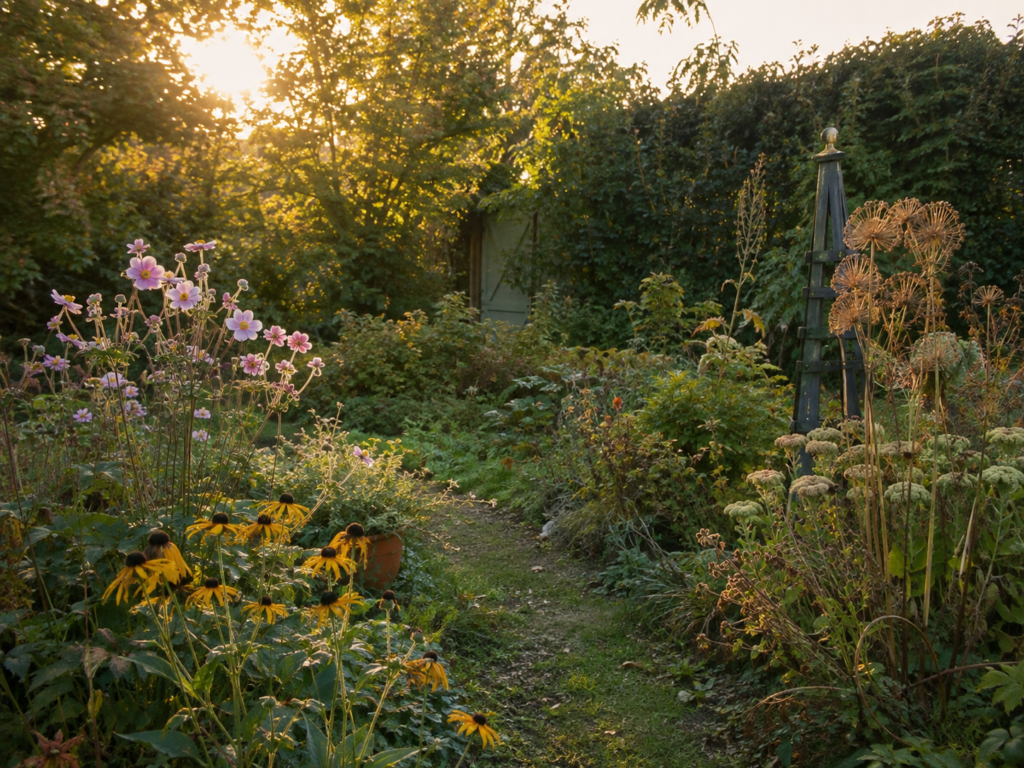
Late August is an untidy time in the garden.
By now, the optimism of May is long gone. In spring, almost everything looks possible. The beds are clean. The plants are small enough to behave themselves. You put something in the ground and imagine what it might become.
August tells the truth.
Some things have flourished. Some have grown far beyond where I expected them to. A few plants are leaning into one another, competing for light. There are flowers still blooming beautifully, though not with the same enthusiasm they had a month ago. Other things are clearly finished, even if I haven’t quite admitted it yet.
And then there are the weeds.
They seem especially pleased with themselves.
I was walking through my backyard recently, looking at what needed attention. There were places I wanted to trim, things I needed to pull, a few areas I was already imagining differently for fall. Soon I’ll bring in mums. The colors will change. The garden will begin the slow turn toward another season.
I have learned not to take any of this personally. A plant fading in August is not failing. A flower that bloomed beautifully in June does not owe me another performance in September. The garden is full of things beginning and ending at the same time, and somehow I find that easier to accept there than in the rest of my life.
Perhaps that is one reason I keep returning to it.
Years ago, this part of our property wasn’t much of a garden at all. There was buckthorn, tall grass, and a patch of ground I began clearing mostly because something needed to be done with it. Eventually I cut three circles into the earth and started walking them. Later came an infinity loop. Then pollinator gardens, inspired by work we were doing through Rotary. Over time there were hanging baskets, wind spinners, places to sit.
I didn’t have a master plan. The place kept becoming. So did I.
Somewhere along the way I began calling it the Mind Garden, which sounds more intentional than its creation actually was. Mostly, I kept noticing what the space seemed to need next.
That may be the part of gardening I have come to appreciate most. You pay attention. You notice what is growing. And then you decide what deserves your care.
Life, strangely, makes this much harder. I can move through an entire day without once asking what I am tending. There are emails to answer, people to call, meetings to attend, things to write, commitments I’ve made because they matter to me. There is work I genuinely love. There are community responsibilities I chose willingly. There are ideas I want to bring into the world.
None of these things are the enemy. That is what makes an overfilled life so difficult to recognize. We imagine an overfilled life must look frantic. We picture someone rushing from place to place, complaining about being busy, barely keeping things together.
Sometimes it looks nothing like that. Sometimes an overfilled life looks meaningful.
- Productive.
- Generous.
- Successful.
- Sometimes nearly everything filling it is something you once said yes to.
I know this because I am very good at filling things. Give me an open afternoon and somewhere in the back of my mind a small committee immediately convenes to discuss its highest and best use. There is always something that could be finished. Something that could be improved. Someone I could reach out to. An idea I could develop.
Even the things meant to restore me can quietly become assignments. Reading becomes something I should keep up with. Meditation becomes something I should be consistent about. A walk becomes an opportunity to think through a problem. Rest begins carrying a job description.
The life may be full of good things and still have very little room in it. That distinction has been following me lately. A full life and an overfilled life can look almost identical from the outside.
The difference may be presence.
A full life still allows us to inhabit it. An overfilled life keeps asking us to move on to whatever comes next. I have experienced this in embarrassingly literal ways. I have traveled somewhere beautiful, sat near water with Al, with nowhere particularly urgent to be, and discovered that while my body had arrived, my mind was somewhere else entirely.
Planning. Rehearsing. Remembering. Solving. The scenery changed. I didn’t.
I had made room on the calendar without making room in myself. That realization has become harder for me to dismiss as I’ve gotten older. Time feels different now. Not frightening, exactly. More visible.
There is less temptation to pretend it is unlimited. And once time becomes visible, the question of what receives it changes. Not dramatically. Quietly.What am I giving my life to? Not what do I say matters to me. Not what would I write down if someone asked about my priorities.
What is actually receiving me?
Gardens are wonderfully unsentimental about this. What receives water tends to grow. What receives sunlight tends to grow. What receives attention tends to grow. And what doesn’t eventually tells the truth.
Human lives are more forgiving, or perhaps simply better at hiding the evidence. We can neglect something important for a surprisingly long time before it appears neglected.
- A friendship.
- A marriage.
- Our body.
- Curiosity.
- Play.
- Silence.
- A part of ourselves that once felt very alive.
Nothing announces its departure. There is rarely a moment when we can say, There. That’s when I stopped paying attention. Meaning tends to disappear more quietly than that.
A little less time here. One more obligation there. Another useful thing. Another worthwhile thing. Another yes.
Until one day something we care about is still technically part of our life but no longer feels alive inside it.
I wonder if this is one of the hidden costs of productivity. Productivity is very good at helping us decide how to do things. It is less reliable at helping us decide what deserves our life.
Those are not the same question. The danger isn’t productivity itself. I like accomplishing things. I like creating. I like contributing. I suspect I always will.
But accomplishment has an appetite. If I don’t pay attention, it will eat whatever I feed it.An hour. An evening. A weekend. A season. And because something useful usually comes out the other side, it is easy to believe the exchange was automatically worthwhile.
The garden asks a different question. Not: How much did you get done? More like: What grew here? I find myself thinking about that as I walk the circles now.
- What has grown in me this year?
- What have I been watering without realizing it?
- What has received so much of my attention that it has become stronger simply through repetition?
There are answers I like. There are others I am less eager to claim. I have cultivated curiosity. I have also cultivated urgency. I have cultivated service. At times, I have cultivated the belief that being useful is the same thing as being present. I have cultivated meaningful work. And occasionally I have allowed meaningful work to crowd out the very life that gives the work its meaning.
Gardens contain weeds and flowers without becoming ashamed of either. I am trying to learn that too. There is something unnecessarily harsh about the way we often examine our lives. The moment we notice something out of alignment, we turn awareness into an indictment.
I should have known better. I need to stop doing this. I have to change.
The gardener in me knows better. You don’t stand over a bed full of weeds and shame the soil. You notice what grew. Then you begin tending differently.
Maybe this is where cultivation differs from self-improvement. Self-improvement so easily begins with the assumption that something about us needs fixing. Cultivation begins with relationship. What is here? What is growing? What needs more room? What has had its season? What might happen if I stopped feeding something that no longer belongs here? These are slower questions. They don’t produce impressive checklists. But they may produce a life.
Soon I’ll put mums around the garden. Some of the summer plants will remain for a while. Others will come out. Leaves will begin falling across the paths faster than I can clear them. Eventually the colors will disappear almost entirely and the garden will enter the long quiet that winter asks of it.
Nothing about that quiet will mean the garden has stopped living. It will simply be another way of being alive. I am beginning to wonder whether our lives need seasons like that too. Times when growth is visible. Times when something is being planted. Times when something needs pruning. And times when perhaps nothing needs to happen at all.
We don’t often give ourselves permission for the last one. We have learned to admire the blooming. We are less comfortable with bare ground. But a garden that never rested would eventually exhaust itself.
Perhaps a person can too.
So lately, when I walk through the Mind Garden, I am trying not to ask what else I should add. I am trying to notice. The flowers still blooming. The plants beginning to fade. The weeds that found their way in while I was paying attention somewhere else. The empty places.
Especially the empty places.
Because I am slowly learning that an empty place does not always need to be filled. Sometimes it is simply ground waiting for another season. And perhaps the question is not whether our lives are full. Most of ours already are. Perhaps the question is whether, somewhere inside all that fullness, there is still enough room to notice what we are becoming.
And enough quiet to choose what we want to cultivate next.
Reflection Question
If your attention is water, what have you been watering lately—and is it what you want to grow?
A Gentle Practice
Sometime today, sit somewhere without bringing anything to accomplish. No journal is necessary. No meditation timer. No need to turn the moment into another practice you perform correctly.
Give yourself five minutes and simply notice what has been receiving most of your attention lately.
Then ask quietly:
Is this what I want to be watering?
You don’t need to change anything yet. Just notice.
Continue the Conversation
Thank you for spending a little time here.
If this conversation reminded you of someone who may need it, I hope you’ll share it with them. And if it stirred a question that continues to stay with you, I’d love to hear it.
Some of my favorite conversations begin after the writing ends.
— Michael
Questions Readers Often Ask
What does it mean to cultivate your life? Cultivation is less about forcing change and more about noticing what repeatedly receives your attention, energy, and care. What we return to regularly often becomes stronger in us.
What is the difference between a full life and an overfilled life? A full life can contain work, relationships, service, creativity, and responsibility while still leaving room for presence. An overfilled life may contain many of the same things but leave little room to actually experience them.
Can productivity become unhealthy even when the work is meaningful? Yes. Meaningful activity can still crowd out reflection, rest, relationships, and presence. The issue isn’t simply how much we accomplish, but whether our activity continues to serve what matters to us.
Why is attention important for personal growth? Attention influences what we repeatedly notice, rehearse, strengthen, and make room for. Over time, those patterns can quietly shape our experience of ourselves and our lives.
How do I know what I am cultivating? Look less at your intentions and more at where your attention actually goes. Your calendar, recurring thoughts, emotional energy, conversations, and habits often reveal what you are tending.
Stay Connected
If these reflections resonate with you, stay connected with Michael and Spirit Rising Coaching.
Join the email list to receive new essays, reflections, and occasional insights on leadership, alignment, identity, and what it means to remain fully human in an age of acceleration.