
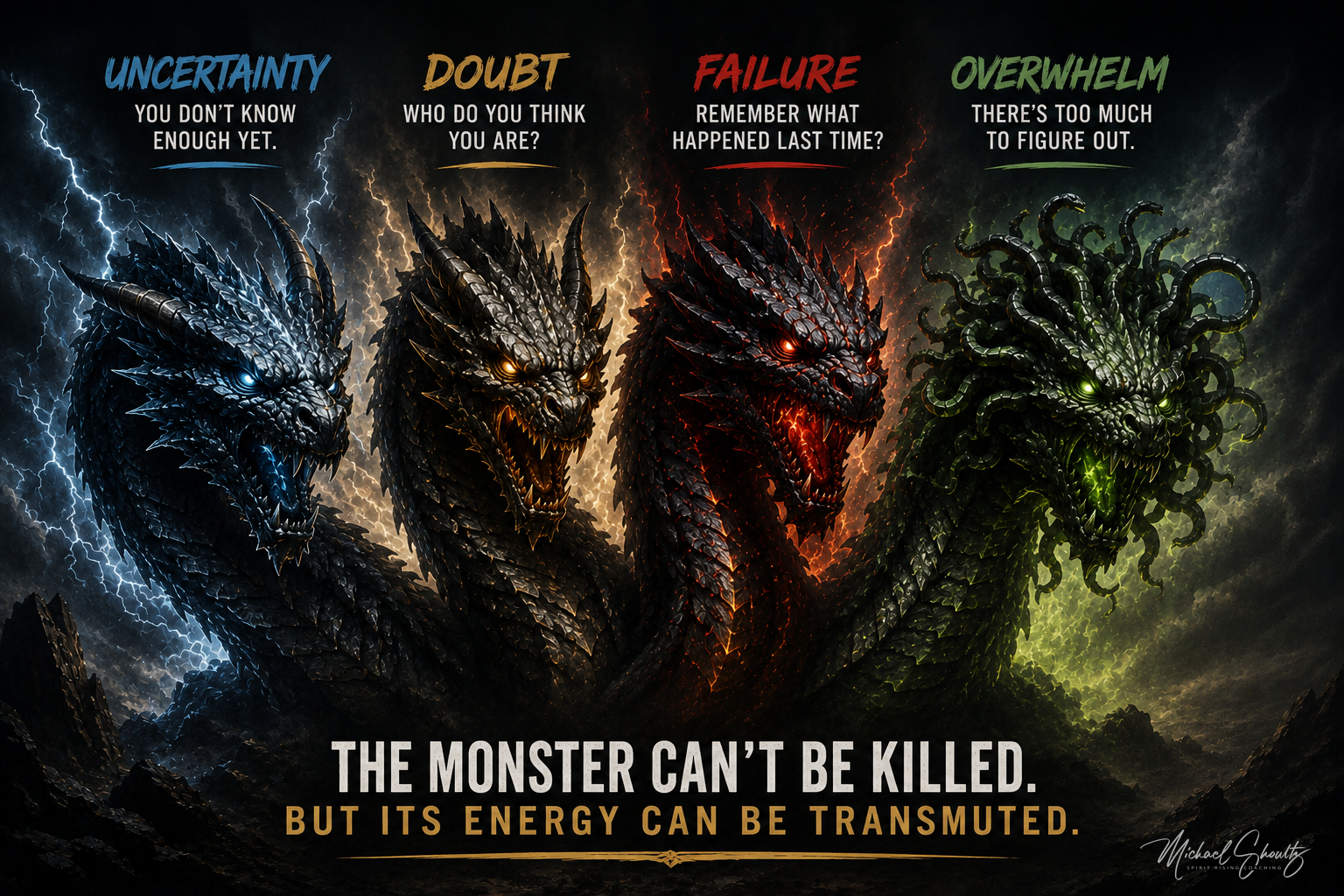
There is something that has stopped more dreams than poverty, more careers than recession, more relationships than betrayal.
We need to talk about the Monster.
If you’ve ever stood on the edge of something big — a business you wanted to build, a conversation you needed to have, a life you could feel pulling at you from just out of reach — and felt something rise up inside you that quietly, convincingly talked you out of it, you know exactly what I mean.
The Monster is real. And I want to introduce you to all four of its heads.
The Monster Cannot Be Killed — And That’s Actually Good News
Here is the first thing most personal development teachers will never tell you, because they’re still trying to sell you the fantasy: you will never kill your Monster. Every time you set out to destroy it and discover, six months later, that it’s still very much alive, you walk away believing the failure is yours. It is not. The Monster cannot be killed because it is not a thing. It is not an entity that lives somewhere inside you, waiting to be defeated with the right weapon.
The Monster is a composite— a stitched-together construction of every belief you have ever accepted, every story you have ever absorbed about who you are and what is possible for your life. Some of it came from parents who loved you and were afraid for you. Some came from teachers who meant well. Some came from a culture that profits when you stay small. Some came from your own past disappointments, calcified over time into rules about what you should not try again.
That composite of beliefs is made from one raw material: thought. And thought is energy. We know — and physics has confirmed what the great mental science teachers articulated long before it — that energy cannot be created or destroyed. It can only be transmuted. Converted from one form to another. Redirected.
Which means the Monster’s energy can absolutely, definitively be transmuted. The same composite of beliefs that today rises up as fear and doubt can, through deliberate practice, be redirected into faith, confidence, and the rehearsal of future possibility.
You are not a passive bystander to this law. You are a creative, causative being. You may not have dominion over whether the Monster speaks — that is governed by law. But you have complete dominion over what energy it becomes once it does.
That is an enormous power. Most people live their entire lives without ever developing it.
So let’s meet the four heads.
Head 1: Uncertainty — “You Don’t Know Enough Yet”
Uncertainty is the first head, and it whispers: “You don’t have all the information. You can’t see the whole staircase, so it’s safer to wait until you can see the whole staircase.”
The Monster insists you must eliminate every uncertainty before you leap. And you think it’s wisdom. You think it’s rational thinking. It isn’t. It’s the Monster trying to keep you ordinary.
Here’s what’s actually true: every quantum leap you’ve ever made happened when you stepped into the unknown. When you moved to a new city where you didn’t know a soul. When you started your business. When you said yes to the relationship. In none of those moments did you have guarantees.
Peak performers don’t try to eliminate uncertainty. They leverage it. And they do it by asking a different question.
When most people face the unknown, they ask: “What could go wrong?” The Monster has a thousand answers ready, locked and loaded. Peak performers ask: “What becomes possible if this works?”
Same uncertainty. Same unknown. Completely different fuel.
That one shift — from what could go wrong to what becomes possible — flips uncertainty from a brake into an accelerator. Try it the next time you catch yourself frozen in front of an unknown. The Monster will hate it. That’s how you’ll know it’s working.
Head 2: Doubt — “Who Do You Think You Are?”
Uncertainty is about the world. Doubt is more personal — it’s about you. Doubt whispers: “You’re not qualified. There are people more talented than you, more experienced than you, better connected than you. What makes you think you can do this?”
But here is what peak performers understand that most people don’t: doubt is not a verdict. It’s an accusation. And every accusation deserves a trial before you accept the sentence. When doubt shows up, most people accept the charge as fact. Peak performers do something different. They demand evidence.
“Where’s the proof? Show me the receipt.”
And here’s what they almost always find: the doubt is borrowing its evidence from a version of you that no longer exists. From the kid who failed the test. From the employee who got passed over. From the entrepreneur whose first business didn’t work.
That was then. The doubt is using expired data.
When you put doubt on trial, you discover something startling — most of what it’s saying about you hasn’t been true for years.
Your doubts can be doorways, not dead ends. When doubt whispers, “You can’t do this,” try this translation: “You can’t do this the old way.” And that is actually good news. The old way got you where you are — not where you want to be.
Head 3: Failure — “Remember What Happened Last Time?”
The Monster uses your past failures as evidence that you should not try again, and your fear of future failure as a reason not to try at all. But failures are not setbacks. They’re data. Every failure is feedback. Every stumble educates you for the next move. That uncomfortable space where you can’t quite see the path — that’s where breakthroughs are born. That’s where you discover capabilities you never knew you had.
Consider Thomas Edison. He conducted somewhere between one thousand and ten thousand failed experiments before successfully creating the incandescent light bulb. He reportedly said, “I have not failed. I’ve just found ten thousand ways that won’t work.”
Edison didn’t wait until he knew how the bulb would work. He acted before he was ready. Each failure was tuition paid to the school of mastery. The bulb that lit New York City was built on a pile of ten thousand failures that would have stopped a lesser person at experiment number ten.
Failure is not the opposite of success. It is the path to it.
Head 4: Fear — The Engine That Powers Them All
Fear is the head that gives all the others their power. It is the engine; uncertainty, doubt, and failure are the body parts the engine drives. Fear doesn’t look like fear. That’s what makes it so effective. It shows up looking like wisdom: “I’m just being realistic.” “I’m just thinking about my family.” “I’m just waiting for the right timing.”
The logic of fear has one tell — one signature you can learn to spot every time: it always argues for the status quo. It never, ever argues for growth.
When you hear yourself constructing a beautifully reasonable case for why you should not take the next step toward your dream, you are listening to the logic of fear in a tuxedo.
The test is simple: does this thought move you toward your dream or away from it? Does it expand you or shrink you? If it consistently calls you back — no matter how reasonable it sounds — it is fear.
Consider the Wright Brothers. In 1903, the very best scientific minds of their era had publicly concluded that heavier-than-air human flight was either impossible or decades away. A New York Times editorial declared a flying machine might be expected in “from one million to ten million years.” Wilbur and Orville — two bicycle mechanics from Dayton, Ohio, with no formal scientific training — rejected the logic. They built. They tested. They failed. They iterated. On December 17, 1903, they flew.
The logic of fear is not actually logical. It is selectively logical. It catalogs everything that could go wrong and ignores everything that could go right. Once you see this, you can never be fully fooled by it again.
There Is a Path Out
The four heads are not the end of the story. They are the beginning of it.
I have spent years studying why some people tame this Monster — and why most don’t. What I’ve found is that it’s not about willpower, personality, or how much you want it. It’s about method. Specifically, a seven-step process for taking the Monster’s energy and transmuting it into forward motion.
The path covers how to reject the Monster’s logic, how to transmute the emotion at its root, how to act before you feel ready, and how to anchor the change so it holds — not just for a week, but for good.
I’ll give you the first step right now, because you can use it tonight.
Step 1: Name the head that is speaking.
That’s it. When the Monster rises, identify which head is active. Uncertainty. Doubt. Failure. Fear. Say it out loud if you have to.
The act of naming it alone begins to reduce its power — because you move from being inside the experience to observing it. You create the space Viktor Frankl described: the gap between stimulus and response where your freedom lives.
One word. That’s the first step. Write it down before you sleep tonight.
Ready to Tame Yours?
The four heads are named. The first step is yours to take tonight. The rest of the path — and the practice behind each step — is what we work through together.
If you read this and recognized your Monster, that recognition is the beginning. The next step is a complimentary discovery call — an honest conversation about which head is loudest in your life right now, and what your next breakthrough could look like.
Michael Shoultz, PhD is the founder of Spirit Rising Coaching, creator of Human Potential Architecture™ and a coach to executives, entrepreneurs, and leaders navigating their next breakthrough.